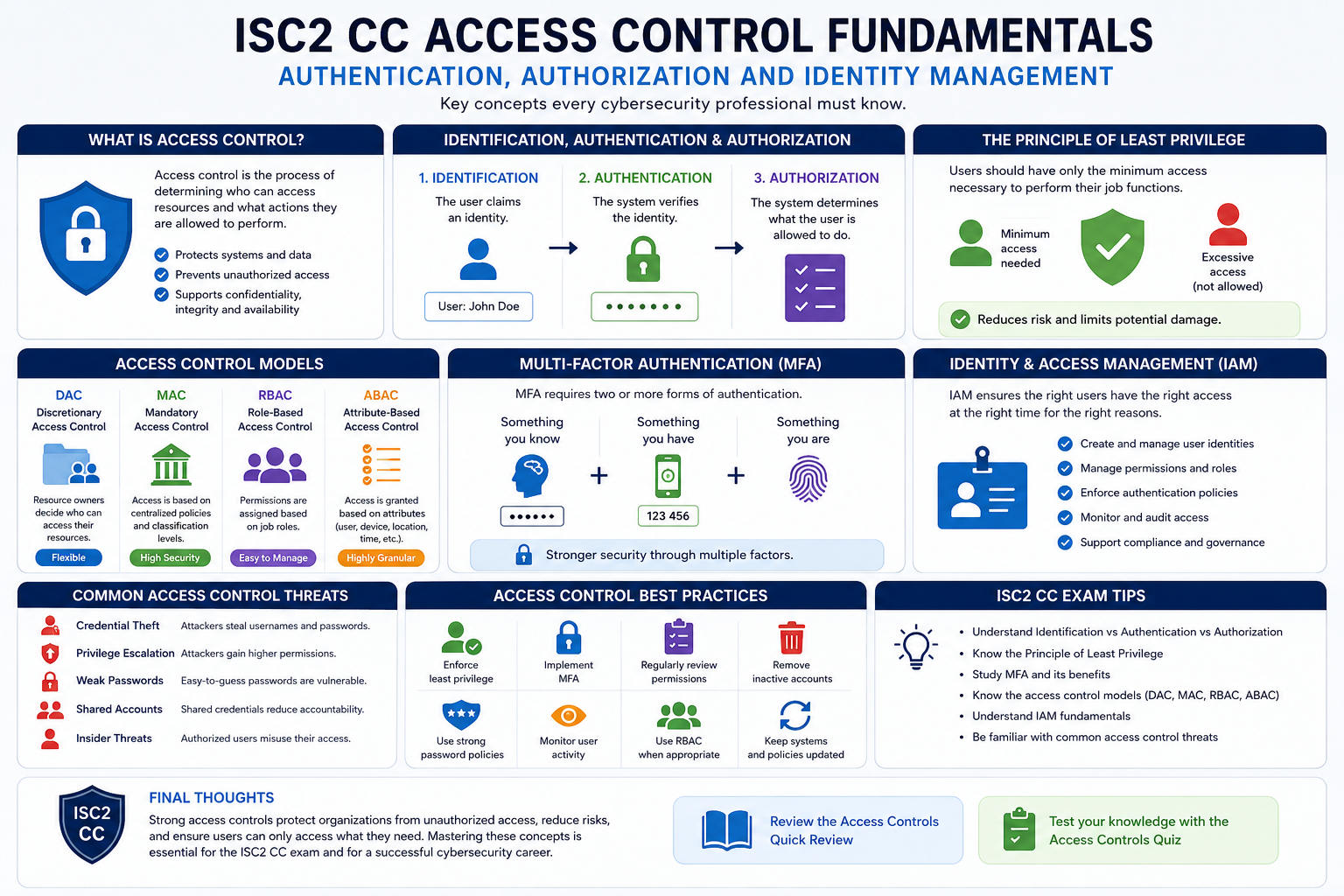
ISC2 CC Access Control Fundamentals: Authentication, Authorization and Identity Management (2026)
Learn the fundamentals of access control, including authentication, authorization, least privilege, MFA, IAM, and access control models for the ISC2 CC exam.
Summary
Access control is one of the most important cybersecurity concepts covered in the ISC2 Certified in Cybersecurity (CC) certification. Understanding authentication, authorization, identity management, access control models, and the principle of least privilege is essential for protecting systems, networks, and sensitive information.
What Is Access Control?
Access control is the process of determining who can access a resource and what actions they are allowed to perform.
Organizations use access controls to protect:
- Systems
- Applications
- Networks
- Databases
- Sensitive information
Without proper access control, unauthorized users could gain access to confidential data, modify critical systems, or disrupt business operations.
Access control is therefore one of the fundamental pillars of cybersecurity.
Identification, Authentication and Authorization
Many beginners confuse these three concepts, but they represent different stages of the access process.
Identification
Identification occurs when a user claims an identity.
Examples:
- Username
- Email address
- Employee ID
Authentication
Authentication verifies that the claimed identity is genuine.
Common authentication methods include:
- Passwords
- PINs
- Smart cards
- Biometrics
Authorization
Authorization determines what an authenticated user is allowed to do.
For example:
- Read files
- Modify records
- Delete information
- Access administrative functions
A user may successfully authenticate but still lack authorization to access specific resources.
The Principle of Least Privilege
The Principle of Least Privilege (PoLP) is one of the most important security principles.
It states that users should receive only the minimum permissions necessary to perform their job functions.
Benefits include:
- Reduced attack surface
- Lower risk of accidental changes
- Better protection against insider threats
- Reduced impact of compromised accounts
Organizations that follow least privilege significantly improve their overall security posture.
Access Control Models
Several access control models are used in modern environments.
Discretionary Access Control (DAC)
DAC allows resource owners to decide who can access their resources.
Advantages:
- Flexible
- Easy to manage
Disadvantages:
- Less secure
- Difficult to control in large organizations
Mandatory Access Control (MAC)
MAC uses centralized security policies and classification levels.
Common in:
- Government environments
- Military systems
- High-security organizations
Advantages:
- Strong security
- Centralized control
Role-Based Access Control (RBAC)
RBAC assigns permissions based on job roles.
Examples:
- Administrator
- Manager
- Employee
- Auditor
RBAC simplifies management and is widely used in enterprise environments.
Attribute-Based Access Control (ABAC)
ABAC evaluates multiple attributes before granting access.
Examples:
- User role
- Device type
- Location
- Time of day
ABAC offers highly granular access control and is increasingly used in cloud environments.
Multi-Factor Authentication (MFA)
Multi-Factor Authentication improves security by requiring more than one form of authentication.
Authentication factors generally fall into three categories:
Something You Know
- Password
- PIN
Something You Have
- Smartphone
- Security token
- Smart card
Something You Are
- Fingerprint
- Face recognition
- Iris scan
MFA significantly reduces the risk of account compromise because attackers must defeat multiple layers of protection.
Identity and Access Management (IAM)
Identity and Access Management (IAM) refers to the policies, technologies, and processes used to manage digital identities.
IAM solutions help organizations:
- Create user accounts
- Manage permissions
- Enforce authentication policies
- Monitor access activities
- Support compliance requirements
Modern cloud platforms such as AWS, Microsoft Azure, and Google Cloud heavily rely on IAM systems.
Common Access Control Threats
Access control systems face numerous threats.
Examples include:
Credential Theft
Attackers steal usernames and passwords through phishing or malware.
Privilege Escalation
Attackers gain higher permissions than intended.
Weak Passwords
Poor password practices increase the likelihood of compromise.
Shared Accounts
Shared credentials reduce accountability and increase security risks.
Insider Threats
Authorized users may intentionally or accidentally misuse their access.
Understanding these risks is essential for cybersecurity professionals.
Access Control Best Practices
Organizations should follow several best practices:
- Enforce least privilege
- Implement MFA
- Regularly review permissions
- Remove inactive accounts
- Use strong password policies
- Monitor user activity
- Apply role-based access controls when appropriate
These measures significantly strengthen organizational security.
ISC2 CC Exam Tips
For the ISC2 CC exam, focus on understanding:
- Identification vs Authentication vs Authorization
- Least Privilege
- MFA concepts
- RBAC, DAC, MAC, and ABAC
- IAM fundamentals
- Common access control threats
The exam emphasizes practical understanding rather than memorization of complex technical details.
Final Thoughts
Access control is a foundational cybersecurity concept that affects every modern organization. By understanding authentication, authorization, least privilege, IAM, and access control models, you will be better prepared for both the ISC2 CC certification and real-world security roles.
Strong access controls help protect systems, reduce risk, and ensure that users only access the resources they genuinely need.
👉 Review the ISC2 CC Access Controls Quick Review.
👉 Test your knowledge with the ISC2 CC Access Controls Quiz.
Discover your level
Take the free test and get your result by email.
Discover your level
Take the free test and get your result by email.
Ready to practice?
Jump into quizzes, train with realistic questions, and track your progress.