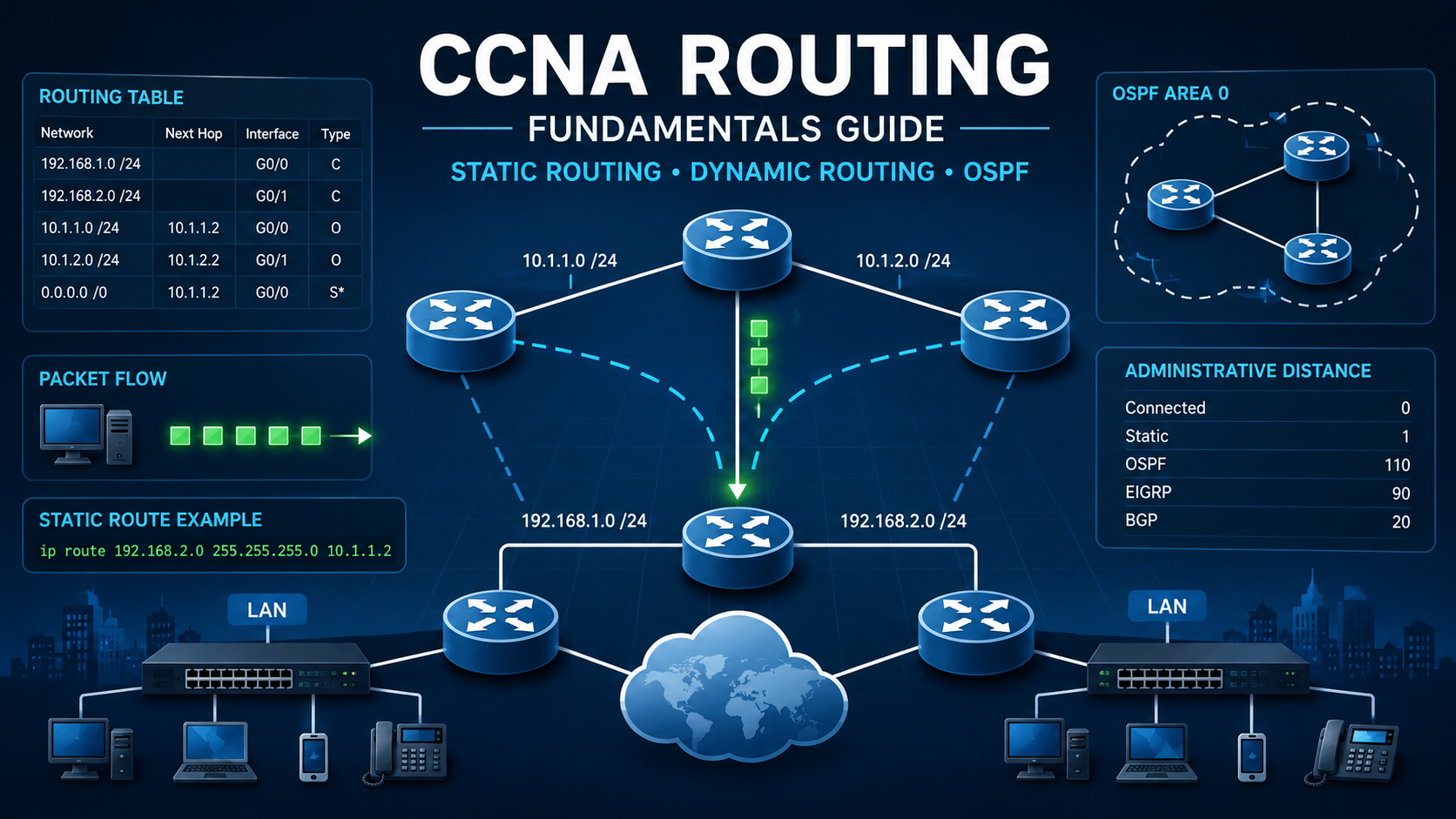
CCNA Routing Fundamentals: Complete Guide to Static Routing, Dynamic Routing and OSPF (2026)
Learn the fundamentals of CCNA routing, including routing tables, static routes, dynamic routing protocols, OSPF basics, and common troubleshooting techniques.
CCNA Routing Fundamentals: Complete Guide to Static Routing, Dynamic Routing and OSPF (2026)
Summary
Routing is one of the most important topics in the Cisco CCNA certification. It allows packets to travel between different networks and enables communication across LANs, WANs, VLANs, and the Internet. Understanding routing tables, static routes, dynamic routing protocols, and OSPF is essential for both the CCNA exam and real-world networking.
What Is Routing?
Routing is the process of forwarding packets from one network to another.
When a device needs to communicate with a destination outside its local network, it sends traffic to a router. The router examines the destination IP address and determines the best path to reach that network.
Without routing, communication would be limited to devices within the same local network.
Routing makes the Internet possible by allowing billions of devices and networks to communicate with each other.
How Routers Make Decisions
Routers make forwarding decisions based on information stored in a routing table.
A routing table contains:
- Destination networks
- Next-hop addresses
- Exit interfaces
- Routing metrics
When a packet arrives, the router compares the destination IP address against its routing table and selects the most specific matching route.
This process is known as the longest prefix match.
The selected route determines where the packet will be forwarded next.
Understanding the Routing Table
The routing table is one of the most important components of a router.
Cisco routers can display the routing table using:
show ip route
Common route types include:
- Connected routes (C)
- Static routes (S)
- OSPF routes (O)
- Default routes (S*)
The routing table continuously changes as networks are added, removed, or updated.
Network administrators frequently examine routing tables when troubleshooting connectivity issues.
Static Routing Explained
Static routing requires manual configuration by an administrator.
Example:
ip route 192.168.20.0 255.255.255.0 10.1.1.2
Advantages of static routing:
- Simple configuration
- Predictable behavior
- No protocol overhead
- Improved security
Disadvantages:
- Poor scalability
- Manual maintenance
- Difficult management in large networks
Static routes are commonly used in small environments and for backup routes.
Dynamic Routing Explained
Dynamic routing allows routers to automatically learn and exchange routes.
Instead of manually configuring every route, routers use routing protocols to discover available networks.
Benefits include:
- Automatic route updates
- Better scalability
- Faster adaptation to network changes
- Reduced administrative workload
Common dynamic routing protocols include:
- OSPF
- EIGRP
- BGP
For the CCNA exam, OSPF is the most important protocol to understand.
OSPF Basics for CCNA
OSPF (Open Shortest Path First) is a link-state routing protocol widely used in enterprise networks.
OSPF routers exchange information about network topology and calculate the best path using the SPF algorithm.
Advantages of OSPF include:
- Fast convergence
- Excellent scalability
- Efficient route calculation
- Open standard support
Basic OSPF configuration:
router ospf 1
network 192.168.1.0 0.0.0.255 area 0
CCNA candidates should understand:
- OSPF neighbors
- Areas
- Link-state advertisements
- DR and BDR concepts
- Route calculation basics
Administrative Distance and Metrics
When multiple routes to the same destination exist, routers must determine which route is preferred.
Administrative Distance (AD) measures the trustworthiness of a route source.
Examples:
- Connected route: 0
- Static route: 1
- OSPF: 110
Routing protocols also use metrics to calculate the best path.
For OSPF, the metric is called cost.
The route with the best combination of administrative distance and metric is selected.
Common Routing Problems
Many networking issues are related to routing misconfigurations.
Common problems include:
- Missing routes
- Incorrect default gateways
- Wrong subnet masks
- OSPF neighbor failures
- Routing loops
- Incorrect administrative distance values
Troubleshooting commands frequently used on Cisco devices include:
show ip route
show ip interface brief
show running-config
ping
traceroute
Learning how to interpret the output of these commands is critical for CCNA success.
CCNA Routing Exam Tips
To perform well on routing questions:
- Learn how routing tables are read.
- Practice subnetting regularly.
- Understand static route configuration.
- Focus on OSPF fundamentals.
- Use Packet Tracer for hands-on labs.
- Learn common troubleshooting commands.
The CCNA exam evaluates understanding and practical application, not just memorization.
Final Thoughts
Routing is one of the core technologies that allows modern networks to function. A strong understanding of routing tables, static routes, dynamic routing protocols, and OSPF will help you succeed on the CCNA exam and build a solid networking foundation.
Before moving to advanced topics, make sure you can confidently read routing tables, identify routes, and explain how routers forward traffic between networks.
Ready to test your knowledge?
Discover your level
Take the free test and get your result by email.
Discover your level
Take the free test and get your result by email.
Ready to practice?
Jump into quizzes, train with realistic questions, and track your progress.